75. VIOLENCE AS THE LANGUAGE OF POLITICS : VIOLENCE IN THE POLITICS OF LANGUAGE
Mahatma Gandhi's chief claim to fame rests solidly on his advocacy of non-violence as a policy. It can be shown that the idea of non-violence under all circumstances is illogical. It can be shown that it did not succeed or even work in his own lifetime.It can be shown that his followers- the Gandhi caps- were more guilty of violence than even the British. But the popular mind does not digest new facts and change its opinion.
Gandhi was sincere. During the Second World War, on 2 July 1940 he appealed to every Briton:
I do not want Britain to be defeated, nor do I want her to be victorious in a trial of brute strength, whether expressed through the muscle or the brain. Your muscular bravery is an established fact. Need you demonstrate that your brain is also as unrivalled in destructive power as your muscle? I hope you do not wish to enter into such an undignified competition with the Nazis. I venture to present you with a nobler and a braver way, worthy of the bravest soldier. I want you to fight Nazism without arms, or, if I am to retain the military terminology, with nonviolent arms. I would like you to lay down the arms you have as being useless for saving you or humanity. You will invite Herr Hitler and Signor Mussolini to take what they want of the countries you call your possessions. Let them take possession of your beautiful island, with your many beautiful buildings. You will give all these but neither your souls, nor your minds. If these gentlemen choose to occupy your homes, you will vacate them. If they do not give you free passage out, you will allow yourself man, woman and child, to be slaughtered, but you will refuse to owe allegiance to them.
But even he had in the end to give up and give in, when Pakistan engineered an invasion of Kashmir. On 29 October 1947, he openly stated that " the job of the armed forces is to march ahead and repel the attacking enemy". Still, Gandhi's was only a reaction to a situation forced on the nation, not his spontaneous action. However, it proves that non-violence and appeasement or pacifism does not serve as state policy. It marks the decisive end of non-violence as a policy tool. Unfortunately, for all his sincerity, and the praise heaped on him posthumously, Gandhi's life did not witness fruitful culmination in any field .
Still, we respect Gandhi because, he at least tried to establish the principle.

Krishnalal Shridharani, a Gandhian follower wrote a beautiful book in1939, (published in India in the 60s), titled "War Without Violence". He stated there succinctly the Gandhian line as: 'adjustment of contending claims instead of annihilating the opposition.' Yet, this is precisely the point: certain evils do not end except with the end of the evil doers. This after all is the lesson of the Gita!
Book cover of the American edition by Harcourt, Brace and Co.Shown here for educational purpose.
Hidden violence in Gandhi
Keen observers have pointed out that Gandhi's methods generated or involved violence indirectly. When he undertook a fast, it usually meant that he was forcing the people to accept his views, which otherwise they might not! His nonviolence directed at his followers also became violence. And he inflicted violence on himself. When a discipline meant for a Sadhu is made into a general rule for political society, tragedy is bound to result.
Violence as reaction
To engage in war when necessary is one thing, but to use violence as a normal state policy is entirely different. India has had to engage in war with China and Pakistan since Independence. It can be surmised that this was mainly because those countries took us to be a 'soft' state and our leaders to be mere talkers. We did not win against China- they went back, as they had come, on their own. But with Pakistan our engagements were decisive. But it has not ended the hostilities or solved the problem. If anything, the problem has become more serious. This is the result of inept political intervention in military strategy. May be India had to yield to some arm twisting by foreign powers. But basically, it was due to unthinking application of an inappropriate principle. It was the bankruptcy of political leadership.
However, in internal matters, Indian govts did not hesitate to use force at the slightest provocation. Whether it was the agitation for linguistic states, the anti-Hindi imposition agitation of Tamil Nadu, even the recent anti-corruption agitation by peaceful means the govts have been rather free with the use of force. Power blinds people, and blocks all sources of thinking.
Our opposition parties are full of the spirit of violence, and incite passions in talking. This is how Shiv Sena grew in the 60s, opposing South Indians. This is how DMK grew, vilifying the Brahmins. They forget that we are a free country and the we cannot be irresponsible in our demands.The central or state govt did nothing , as local sentiments were invoked and the congress party, a national party, then in power wanted to be goody goody.
But the government also does not listen to grievances,
unless there is a show of force, if not violence. See how the peaceful agitation by Anna Hazare and Baba Ramdev was dealt with by the central govt. One wonders whether Man Mohan Singh as PM had any sense, or say in the government.
But the government also does not listen to grievances,
unless there is a show of force, if not violence. See how the peaceful agitation by Anna Hazare and Baba Ramdev was dealt with by the central govt. One wonders whether Man Mohan Singh as PM had any sense, or say in the government.

By Pankaj Jangid (Flickr) CC BY-SA 2.0 creative commons via Wikimedia commons.
Gandhian methods are not respected or cared about in free India.
Violence as State policy
Perhaps no one epitomises the use of force as state policy as Hitler in recent history. His attempt to exterminate the Jews as a race is violent madness at its worst. That such a policy was supported by the people of Germany, educated and civilized, passes comprehension.
But people are not aware that Stalin and Mao Zedong were bigger mass murderers of their own innocent people.
But people are not aware that Stalin and Mao Zedong were bigger mass murderers of their own innocent people.
It is estimated that Hitler caused the deaths of about 46 million people by his war policies. This includes the death of 12 million Jews and others in the Holocaust, all civilians, besides many other civilians.
Stalin is responsible for the deaths of between 56 and 62 million people.
The number killed by Mao Zedong in his regime is estimated at 70 million.

Violence in subtle form:
India's language policy
Murder of people is the most visible form of violence. But modern States are capable of violence in endless subtle ways. It is surely violence when some one is deprived of his life. But what if someone is asked or forced to give up his language?
This is what is happening in various states in India. The central government has forced Hindi on every one as the national language. This example is followed in the states. Take Bihar for example. The following table gives the various languages spoken there and what happened to them.
This is what is happening in various states in India. The central government has forced Hindi on every one as the national language. This example is followed in the states. Take Bihar for example. The following table gives the various languages spoken there and what happened to them.
Languages included in Bihari group[edit]
| Language[7] | ISO 639-3 | Scripts | No. of Speakers[6] | Geographical Distribution |
|---|---|---|---|---|
| Angika | anp | Previously Anga Lipi; Devanagari | 743,600[8] | North Bihar and Eastern Bihar, North-easternJharkhand, West Bengal, Nepal |
| Bajjika | — | Devanagari | 87,38,000[citation needed] | North-Central Bihar Eastern Terai |
| Bhojpuri | bho | Previously Kaithi; Devanagari | 3,85,46,000 | Western Bihar, Eastern Uttar Pradesh and CentralTerai, Southern Nepal |
| Fiji Hindi[9] | hif | Latin and Devanagari | 460,000 | Fiji Islands |
| Kudmali | kyw | Devanagari, Chis (also suggested as its possible script) | 37,000 | Eastern Jharkhand, West Bengal |
| Magahi | mag | Previously Kaithi; Devanagari | 2,03,62,000 | South-Western Bihar |
| Maithili | mai | Maithili variant of Eastern Nagari script,Devanagari | 3,38,90,000 | Northern Bihar, Official Status in  Madhesh,Nepal Madhesh,Nepal |
| Majhi | mjz | N.A | 21,841 | Eastern Bihar, Nepal |
| Musasa | smm | N.A | 50,000 | Eastern Bihar, Nepal |
| Panchpargania | tdb | Devanagari, sometimes Bengali & Kaithi | 274,000 | West Bengal Jharkhand Assam |
| Sadri | sck | Devanagari | 165,683 | Jharkhand Bihar and Bangladesh |
| Khortha | sdr | Eastern Nagari script, Devanagari | 19,65,000 | Northern Jharkhand |
| Sarnami Hindustani[10] | hns | Latin, Devanagari | 150,000 | Suriname |
| Surjapuri | sjp | Devanagari | 273,000 | North-eastern Bihar |
The figures are taken from Wikipedia.
What is important to remember is that the language of the State is stated to be Hindi, and none of these languages were granted constitutional status. It was only in 2003 that Maithili was granted recognition. Others were ignored. Bhojpuri, language spoken by nearly four crore people, and Magadhi spoken by over two crore people are ignored in the name of official Hindi. But does number really matter? Do people lose their right to their language if they cannot muster numbers?
Does this not amount to violence?
Govt of India and all the so called national parties are really Hitlerite or Stalinist - absolutely brutal and idiotic in the matter of language. They want to proclaim one language as the national language. When a nation has many rich and ancient native languages, how can any one be proclaimed as the national language?
For this purpose, the misguided Hindi fanatics are grouping various languages under Hindi, to create the illusion that it is spoken by a majority of Indians. No doubt under the compulsion of the Official language acts, people who speak different languages in Bihar have to declare their language as Hindi. Many people in other states are also indirectly compelled to learn govt-enforced Hindi, in the interest of inter-state mobility. But our parties are interested in petty communal politics and do not care for deeper cultural freedoms. As the children enrol in schools and are taught the official version of the language, they will have no means of knowing that they do indeed have a different language. It will slowly die.
Minority languages in states
If this is what the Centre is doing, the states are not far behind. After the formation of linguistic states, those speaking minority languages do not get official recognition for official business.Urdu alone got recognition in UP and Bihar because of vote bank politics. One has to compulsorily follow the state language. There is thus effective discrimination on the basis of language, whatever the constitution may say.
Take Tulu for example. Though over 5 million people speak it as their mother tongue all over the world, it has no official status in Karnataka where the Tulu speaking people mainly live in India. What kind of linguistic reorganization have we created if such languages can be bulldozed? Does it not amount to violence? Should the people then indulge in violence to get their voice heard?

This was written in 1391 A.D. Used here for educational purposes.
There are not less than four dialects or strands of Tulu- the language is so rich!

Tulu script compared with Kannada and Malayalam scripts. Tulu can reassert itself only if it revives its own script. If they use Kannada script, they will be swallowed by Kannada.
Ancient Tamils recognised Tulu speakers as a distinct community and the area they lived was called Tuluva naadu.
Konkani has luckily survived because it is identified with Goa, though Konkani speakers live in widespread areas. They also write Konkani in five scripts, as shown below:
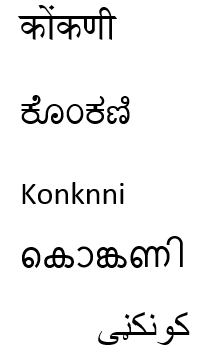
We should not confuse a language with a script. Tulu may be written in Kannada script, but it had other scripts also. Seeing how native languages are suppressed in spite of the formation of linguistic states, we must find other methods of restoring the full linguistic rights and freedom of all people, irrespective of the number of speakers, irrespective of where they live in India.
We must learn to respect and honour all languages.
If we adopt the policy of 'mother tongue plus English' all language difficulties and prejudices will disappear and all Indians will be equal. But it will cut at the very root of Hindi imperialism, which has succeeded British imperialism. It will also disturb the regional linguistic sultanates in the states.
Today, non-Hindi speaking people are second-class citizens in India. This is the greatest violence done by the State to peaceful people.
And those who do not speak the state language are second class citizens in the states. Such discrimination based on language never historically existed in India.
Hindi advocates are ardent hypocrites. They merrily learn English and their mother tongue and want every one else to learn more than two languages.
This is something for all sober people to reflect upon seriously.
NOTE:
Tamil Nadu is one of the worst states in the treatment of linguistic minorities.
Tamil may be the mother tongue of a majority of the population. But the number of people who speak Telugu, Malayalam. Urdu, Kannada, Hindi, Saurashtram, Tanjore Marathi,and about 20 other languages is not insignificant. Whatever their number they too have got their right to their language. But the state govt does not recognise this position. In the recent state level educational reform, they have fixed only two languages - Tamil and English- as compulsory for all students in the school system.at the X Standard. Minorities have no rights!
As a report in The Hindu noted:
The State government's move to make Tamil compulsory from 2006 in all schools was another stumbling block for minority language schools as Tamil took precedence over minority languages. The Linguistic Minorities Forum of Tamilnadu, which has been making many representations to the government, wants Tamil Nadu to implement the three-language formula as followed in most States, including Andhra Pradesh, Delhi, West Bengal and Karnataka.
Tamil Nadu follows the two-language formula, where Tamil is the first language and English the second. Under the Act of 2006, the mother tongue can be taught as an elective subject, but there is no public examination so far, say language teachers.
“The minority language school students study three languages (Tamil, English and mother-tongue), whereas local students read only two languages (Tamil and English),” says C.M.K. Reddy, Chairman, Linguistic Minorities Forum of Tamilnadu.
A majority of the parents would not want to burden their child with an additional language, thus the strength of these schools is decreasing leading to their gradual closure.From: The Hindu, Chennai, November 29, 2010.

Recently, Tamil Nadu has decided to implement compulsory Tamil for the students. As a result, the students of Minority Languages were unable to choose their Mother Tongue in educational institutions in the state.
As per the sources, Pawan Kalyan decided to fight against the Government of Tamil Nadu Government for the recognition of Telugu language in the state. He is going to stage a dharna in Hosur in the last week of September.- Report in Telugu Mirchi, 16 September, 2015.
In effect this arrangement is so unequal, so unfair. It means that a minority student has to learn 4 languages: English, Tamil, Mother tongue, and Hindi- so called national language. A Tamilian will quietly learn just two: Tamil, his mother tongue, and English! Anyone who speaks for the minority rights will be condemned as "Tamil traitor".
What will happen to India if every state adopts this policy?
Such developments show how absurd is the linguistic reorganization of states.


